 Animals
180 sourced facts
Animal facts
Surprising animal facts that are actually true. Tap any card for the details and the source, then download or share it.
Animals Animals
 Animals
 Animals
 Animals
 Animals
 Animals
 Animals
 Animals
 Animals
 Animals
 Animals
 Animals
 Animals
 Animals
 Animals
 Animals
 Animals
 Animals
 Animals
 Animals
 Animals
 Animals
 Animals
 Animals
 Animals
 Animals
 Animals
 Animals
 Animals
 Animals
 Animals
 Animals
 Animals
 Animals
 Animals
 Animals
 Animals
 Animals
 Animals
 Animals
 Animals
 Animals
 Animals
 Animals
 Animals
 Animals
 Animals
 Animals
 Animals
 Animals
 Animals
 Animals
 Animals
 Animals
 Animals
 Animals
 Animals
 Animals
 Animals
 Animals
 Animals
 Animals
 Animals
 Animals
 Animals
 Animals
 Animals
 Animals
 Animals
 Animals
 Animals
 Animals
 Animals
 Animals
 Animals
 Animals
 Animals
 Animals
 Animals
 Animals
 Animals
 Animals
 Animals
 Animals
 Animals
 Animals
 Animals
 Animals
 Animals
 Animals
 Animals
 Animals
 Animals
 Animals
 Animals
 Animals
 Animals
 Animals
 Animals
 Animals
 Animals
 Animals
 Animals
 Animals
 Animals
 Animals
 Animals
 Animals
 Animals
 Animals
 Animals
 Animals
 Animals
 Animals
 Animals
 Animals
 Animals
 Animals
 Animals
 Animals
 Animals
 Animals
 Animals
 Animals
 Animals
 Animals
 Animals
 Animals
 Animals
 Animals
 Animals
 Animals
 Animals
 Animals
 Animals
 Animals
 Animals
 Animals
 Animals
 Animals
 Animals
 Animals
 Animals
 Animals
 Animals
 Animals
 Animals
 Animals
 Animals
 Animals
 Animals
 Animals
 Animals
 Animals
 Animals
 Animals
 Animals
 Animals
 Animals
 Animals
 Animals
 Animals
 Animals
 Animals
 Animals
 Animals
 Animals
 Animals
 Animals
 Animals
 Animals
 Animals
 Animals
 Animals
 Animals
 Animals
 Animals
 Animals
 Animals
Animal facts: all 180, explained
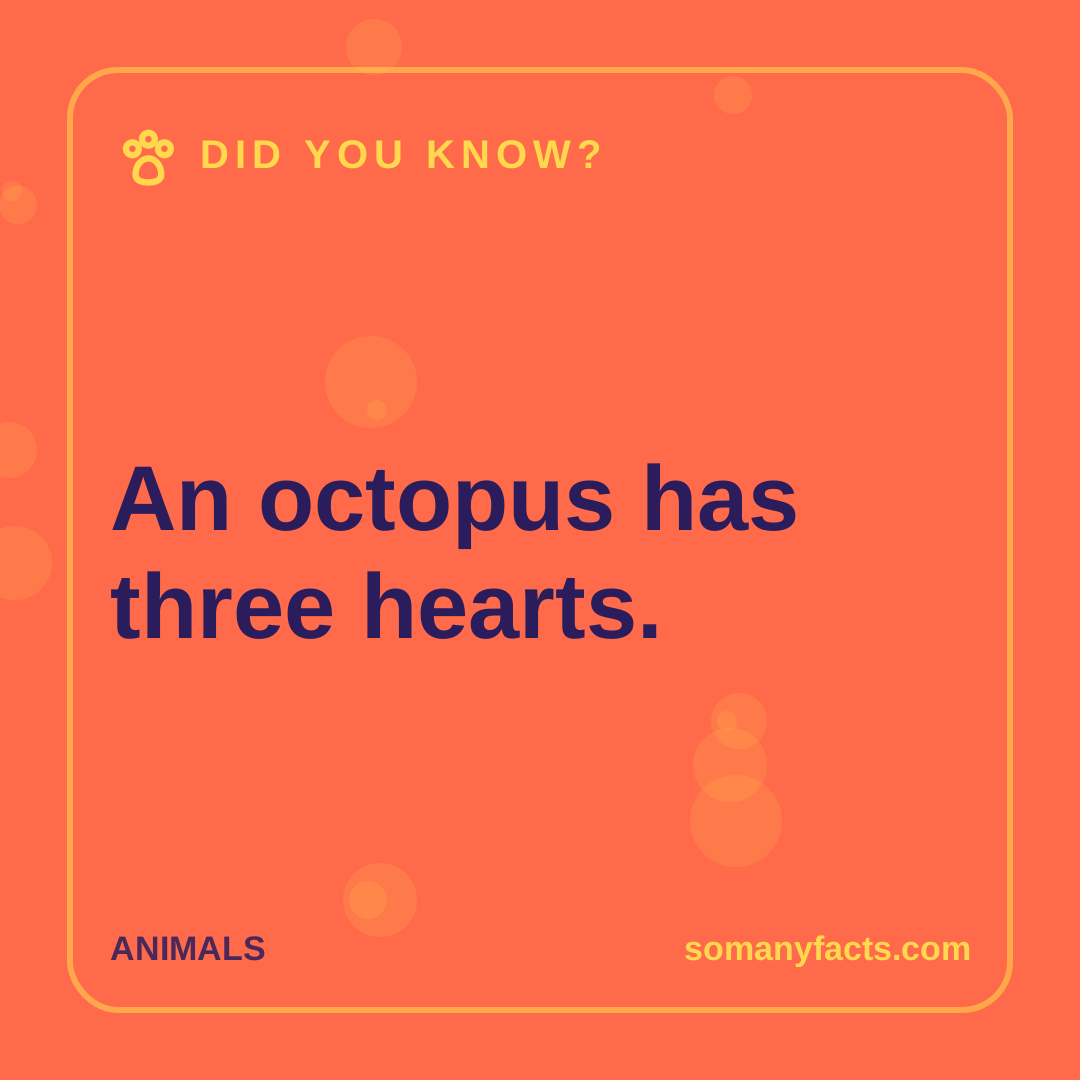
An octopus has three hearts.
Two hearts pump blood through the gills, and the third pumps it around the rest of the body. The main heart actually stops beating while the octopus swims, which is one reason octopuses prefer crawling. Their blood is blue because it uses a copper-based protein, hemocyanin, to carry oxygen.
Source: Octopus (Wikipedia) · Fact card
Wombats produce cube-shaped poop.
Wombat droppings come out as rough cubes, and a wombat can produce dozens a night. Researchers found the shape forms in the last part of the intestine, where the gut walls stretch unevenly. Wombats stack the cubes on rocks and logs to mark territory, and the flat sides stop them rolling away.
Source: Wombat (Wikipedia) · Fact card
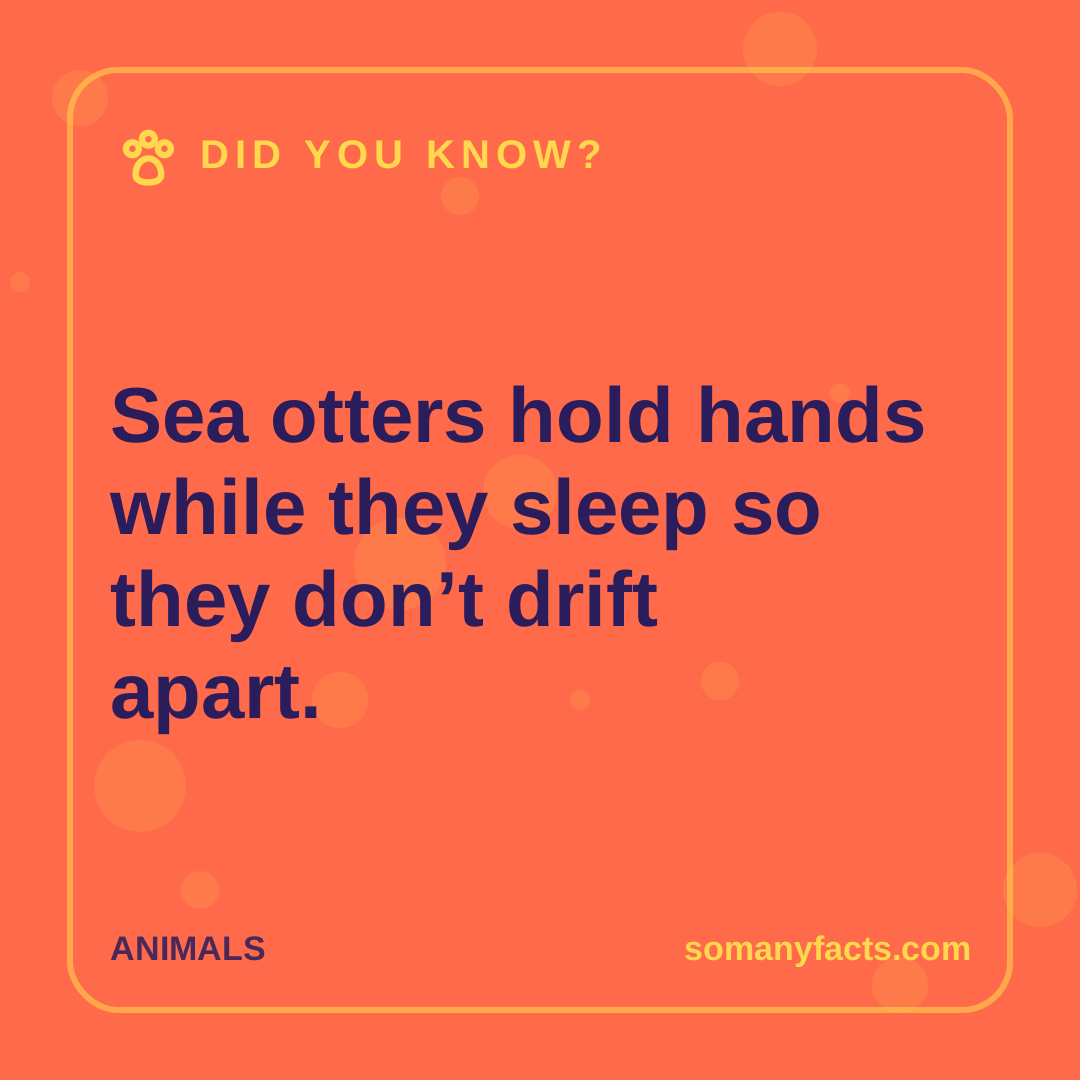
Sea otters hold hands while they sleep so they don’t drift apart.
Sea otters rest floating on their backs, and groups called rafts sometimes link paws or wrap themselves in kelp to stay together on the current. They also have the densest fur of any animal, which keeps them warm without a layer of blubber.
Source: Sea otter (Wikipedia) · Fact card
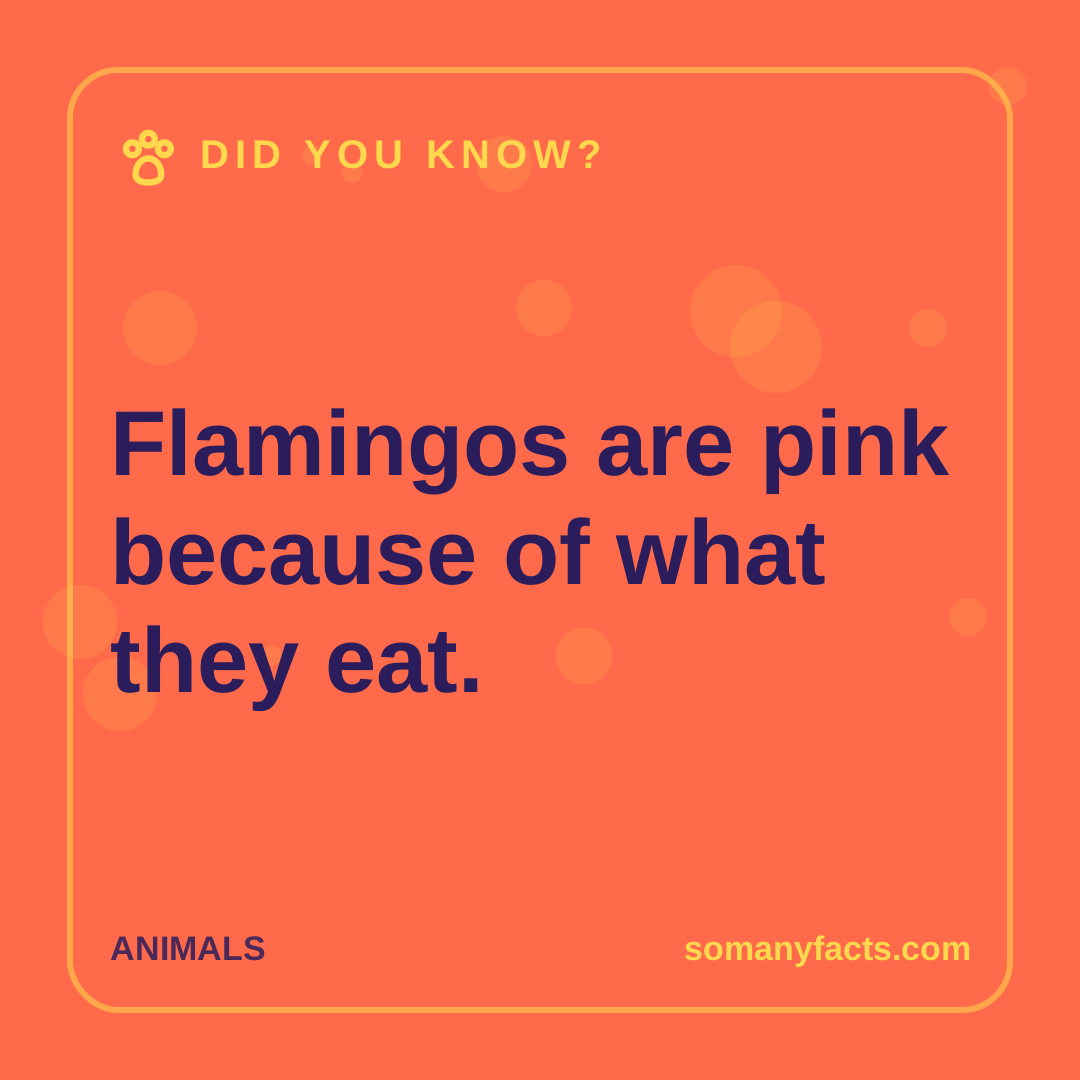
Flamingos are pink because of what they eat.
Flamingo chicks are born grey or white. Their pink color comes from carotenoid pigments in the algae and brine shrimp they eat. A flamingo on a poor diet slowly fades towards white, which is why zoos add carotenoids to their food.
Source: Flamingo (Wikipedia) · Fact card
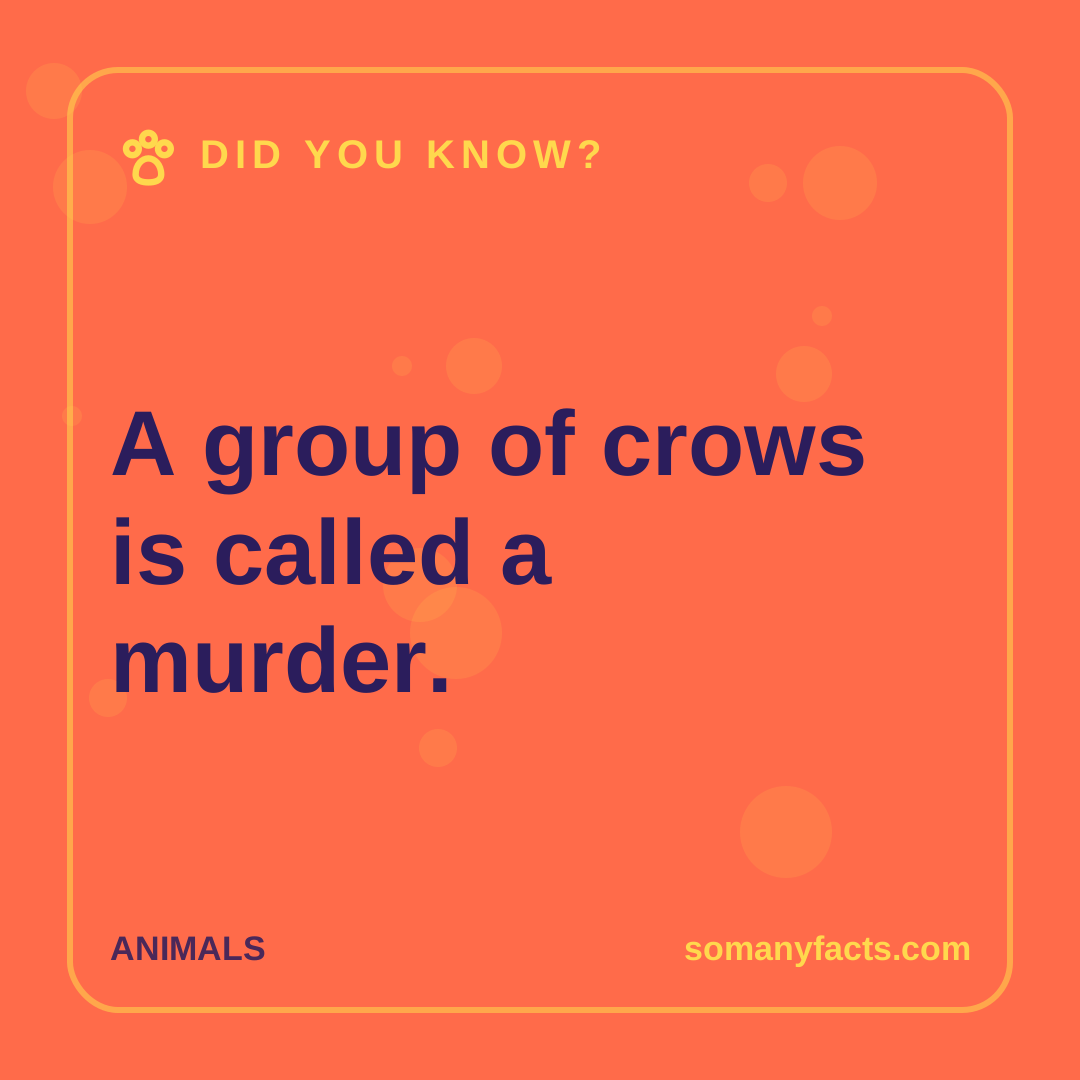
A group of crows is called a murder.
The collective noun dates back to English hunting terms of the 1400s, when many animal groups were given colorful names. Others from the same tradition include a parliament of owls and an exaltation of larks. Crows themselves are among the most intelligent birds, able to use tools and recognize human faces.
Source: Crow (Wikipedia) · Fact card
A shrimp’s heart is in its head.
In shrimp, most of the vital organs, including the heart and stomach, sit in the front section of the body called the cephalothorax, which is the head and thorax fused together.
Source: Shrimp (Wikipedia) · Fact card
Koalas have fingerprints almost identical to humans.
Koala fingerprints have loops and whorls so similar to ours that they are hard to tell apart even under a microscope. They evolved separately from primate fingerprints, probably to help koalas grip branches and handle eucalyptus leaves.
Source: Koala (Wikipedia) · Fact card
Starfish have no brain and no blood.
Sea stars use a network of nerves instead of a brain, and they move water through their bodies instead of blood. Many species can regrow lost arms, and some can regrow an entire body from a single arm with part of the central disc.
Source: Starfish (Wikipedia) · Fact card
Hummingbirds are the only birds that can fly backwards.
Hummingbirds rotate their wings in a figure-eight pattern, which lets them hover in place and fly backwards, a skill no other bird group has for sustained flight. Their hearts can beat more than 1,000 times a minute during flight.
Source: Hummingbird (Wikipedia) · Fact card
Elephants are one of the few mammals that cannot jump.
Adult elephants are too heavy and their leg bones point straight down, without the springy ankles other mammals use to push off. They can still walk fast, reaching around 25 km/h, while always keeping at least one foot on the ground.
Source: Elephant (Wikipedia) · Fact card
Cats cannot taste sweetness.
Cats lack a working version of one of the two genes needed for the sweet taste receptor. As strict carnivores, they had little use for detecting sugar. Lions and tigers share the same missing receptor.
Source: Cat senses (Wikipedia) · Fact card
Axolotls can regrow limbs, parts of their heart and even parts of their brain.
The axolotl, a salamander from lakes near Mexico City, can regenerate lost body parts without scarring. It also keeps its juvenile features, like feathery external gills, its whole life. In the wild it is critically endangered.
Source: Axolotl (Wikipedia) · Fact card
Tardigrades have survived exposure to outer space.
Tardigrades, or water bears, are tiny animals under a millimetre long. In 2007 some were sent into low Earth orbit and exposed to the vacuum of space, and some survived and later reproduced. They survive extremes by drying out into a dormant state.
Source: Tardigrade (Wikipedia) · Fact card
Owls cannot move their eyes.
An owl’s eyes are tube-shaped and held in place by bony rings, so they cannot roll in their sockets. Instead, owls can turn their heads about 270 degrees, thanks to extra neck vertebrae and special blood vessel adaptations.
Source: Owl (Wikipedia) · Fact card
Some male penguins give pebbles to females they want to mate with.
Gentoo and Adélie penguins build nests from stones, and good pebbles are precious. Males present pebbles to females, and the pair use them to build a nest that keeps their eggs above meltwater. Penguins also steal stones from their neighbors.
Source: Gentoo penguin (Wikipedia) · Fact card
A blue whale’s heart weighs about as much as two grown men.
The blue whale is the largest animal known to have ever lived, reaching around 30 metres long. A blue whale heart studied in Canada weighed about 180 kilograms. Its call is one of the loudest sounds made by any animal.
Source: Blue whale (Wikipedia) · Fact card
Slugs have four noses.
Slugs have two pairs of tentacles. The upper pair carries light-sensing eye spots and the lower pair is used for smell and touch, so all four tentacles can sense smell. If one is lost, it can grow back.
Source: Slug (Wikipedia) · Fact card
One species of jellyfish can turn back into a younger form.
Turritopsis dohrnii, the so-called immortal jellyfish, can revert from its adult form back to a juvenile polyp when stressed or injured, starting its life cycle again. It can still die from disease or being eaten.
Source: Turritopsis dohrnii (Wikipedia) · Fact card
Greenland sharks can live for hundreds of years.
A 2016 study using radiocarbon dating estimated that Greenland sharks can live at least 272 years, and possibly much longer, making them the longest-living vertebrates known.
Source: Greenland shark (Wikipedia) · Fact card
The pistol shrimp snaps its claw so fast it makes a bubble almost as hot as the Sun’s surface.
When a pistol shrimp snaps its claw, it shoots out a jet of water that forms a collapsing bubble. The collapse makes a loud crack and, for an instant, temperatures estimated at over 4,000 °C. The shock wave is enough to stun small prey.
Source: Alpheidae (Wikipedia) · Fact card
Cats sleep for around 12 to 16 hours a day.
Cats are crepuscular, meaning they are most active around dawn and dusk. Between those bursts of hunting and play, they spend most of the day dozing, which saves energy for short, intense activity.
Source: Cat (Wikipedia) · Fact card
Cats have a built-in reflex that turns them feet-first when they fall.
The "righting reflex" lets a falling cat twist its body around to land on its feet. Kittens start to show it at around three to four weeks old and have it well developed by about seven weeks. Cats have a flexible backbone and no working collarbone, which helps.
Source: Cat righting reflex (Wikipedia) · Fact card
Adult cats rarely meow at each other. They mostly meow at people.
Kittens meow to their mothers, but adult cats mainly use hisses, growls, scent and body language with other cats. Meowing seems to have carried on into adulthood largely as a way to talk to humans.
Source: Cat communication (Wikipedia) · Fact card
A cat was buried with a person in Cyprus about 9,500 years ago.
Archaeologists on Cyprus found a cat buried close to a human in a grave dated to around 7500 BC. Cats are not native to Cyprus, so people must have brought them by boat, which shows cats lived alongside humans long before ancient Egypt.
Source: Cat (Wikipedia) · Fact card
Cats have a third eyelid.
The nictitating membrane is a thin inner eyelid that sweeps across the eye from the inner corner to protect and moisten it. You do not usually see it, but it can show when a cat is sleepy or unwell.
Source: Nictitating membrane (Wikipedia) · Fact card
A dog’s nose has hundreds of millions of scent receptors, compared with a few million in ours.
Dogs have far more olfactory receptors than humans and a much larger part of the brain for processing smells. That is why they can be trained to find people, drugs, explosives and even some diseases by scent.
Source: Dog anatomy (Wikipedia) · Fact card
Dogs sweat mostly through their paw pads.
Dogs have very few sweat glands in their skin. They cool down mainly by panting, which evaporates water from the tongue and airways, with a little sweating through the pads of their feet.
Source: Dog anatomy (Wikipedia) · Fact card
Greyhounds can run at about 70 km/h (around 45 mph).
Greyhounds are the fastest dog breed. Their long legs, deep chest, flexible spine and light frame let them reach top speed within a few strides, though they are built for sprinting rather than long distances.
Source: Greyhound (Wikipedia) · Fact card
The basenji is a dog that doesn’t bark. It yodels.
The basenji, an African hunting breed, has an unusually shaped larynx. Instead of a typical bark it makes a sound often described as a yodel, which has earned it the nickname "barkless dog".
Source: Basenji (Wikipedia) · Fact card
Dogs were the first animals to be domesticated, more than 15,000 years ago.
Dogs descend from an ancient population of wolves and were domesticated by hunter-gatherers well before farming began. They were tamed long before any crop or other animal.
Dogs aren’t color-blind. They see mostly in blues and yellows.
Humans have three types of color-sensing cone cells; dogs have two. That gives them dichromatic vision similar to red-green color blindness in people, so red and green look alike to them but blue and yellow stand out.
Source: Dog anatomy (Wikipedia) · Fact card
Dalmatian puppies are born completely white.
Dalmatian puppies are born with plain white coats. Their famous spots start to appear after a couple of weeks and keep developing for months.
Source: Dalmatian dog (Wikipedia) · Fact card
Sharks have been around longer than trees.
The earliest sharks appeared more than 400 million years ago. The first trees appeared later, around 385 million years ago. Sharks have since survived several mass extinctions.
Source: Shark (Wikipedia) · Fact card
Sharks don’t have a single bone in their bodies.
A shark’s skeleton is made of cartilage, the same flexible material in your nose and ears. Cartilage is lighter than bone, which helps sharks stay buoyant.
Source: Shark (Wikipedia) · Fact card
Sharks keep growing new teeth throughout their lives.
Sharks have rows of teeth that move forward like a conveyor belt. When a front tooth falls out, one from behind replaces it, so some sharks get through thousands of teeth in a lifetime.
Source: Shark tooth (Wikipedia) · Fact card
The biggest fish in the world is a shark that eats tiny plankton.
The whale shark can grow to about 18 metres long, but it is a gentle filter feeder. It swims with its mouth open, straining plankton and small fish from the water.
Source: Whale shark (Wikipedia) · Fact card
Sharks can sense the electric fields of other animals.
Jelly-filled pores on a shark’s snout, called ampullae of Lorenzini, detect the tiny electric signals made by the muscles and nerves of prey, even when it is hidden in sand.
Source: Ampullae of Lorenzini (Wikipedia) · Fact card
Some sharks have to keep swimming to breathe.
Species such as the great white and mako rely on "ram ventilation": swimming with their mouths open so water flows over their gills. Other sharks can pump water over their gills while resting on the sea floor.
Source: Shark (Wikipedia) · Fact card
Emperor penguins can dive more than 500 metres deep.
The emperor penguin is the deepest-diving bird. Dives of over 500 metres have been recorded, and they can stay underwater for more than 20 minutes while hunting fish, squid and krill.
Source: Emperor penguin (Wikipedia) · Fact card
Emperor penguin dads keep their egg warm on their feet for about two months.
After the female lays a single egg, the male balances it on his feet under a fold of skin through the Antarctic winter, eating nothing until the chick hatches. Males huddle together in large groups to survive the cold.
Source: Emperor penguin (Wikipedia) · Fact card
Only one kind of penguin lives naturally north of the equator, and only just.
Penguins live almost entirely in the Southern Hemisphere. The Galápagos penguin, which lives around islands on the equator, is the only species whose range crosses into the north.
Source: Galápagos penguin (Wikipedia) · Fact card
Penguins can drink seawater.
A gland above a penguin’s eyes filters excess salt from its blood. The salty fluid drains out through the bill, which is why penguins sometimes seem to sneeze or drip.
Source: Supraorbital gland (Wikipedia) · Fact card
Owls fly almost silently.
The front edges of many owls’ flight feathers are comb-like and their surfaces are soft, which breaks up the turbulence that makes noise. That lets them swoop on prey without being heard.
Source: Owl (Wikipedia) · Fact card
Some owls have one ear higher than the other.
Barn owls and several other species have ear openings at different heights. Sound reaches each ear at slightly different times and volumes, which lets the owl pinpoint prey in complete darkness.
Source: Owl (Wikipedia) · Fact card
Owls swallow small prey whole and cough up the bones as pellets.
Owls cannot digest bones, fur or feathers, so their stomach packs them into a pellet that the owl brings back up. Scientists and school classes dissect owl pellets to see what owls eat.
Source: Pellet (ornithology) (Wikipedia) · Fact card
A giraffe has the same number of neck bones as you: seven.
Nearly all mammals have seven neck vertebrae. In a giraffe, each one can be more than 25 centimetres long.
Source: Giraffe (Wikipedia) · Fact card
Male seahorses are the ones that get pregnant.
The female places her eggs in a pouch on the male’s belly. He fertilises and carries them until they hatch, then releases tiny baby seahorses into the water.
Source: Seahorse (Wikipedia) · Fact card
Polar bears have black skin under their white-looking fur.
A polar bear’s fur is made of hollow, transparent hairs that scatter light and look white. Underneath, its skin is black, which helps absorb heat.
Source: Polar bear (Wikipedia) · Fact card
Bats are the only mammals that can truly fly.
Flying squirrels and some other mammals glide, but bats are the only ones capable of sustained, powered flight. A bat’s wing is a thin membrane of skin stretched over very long finger bones.
Source: Bat (Wikipedia) · Fact card
Butterflies taste with their feet.
Butterflies have taste sensors on their feet. Females use them to check whether a leaf is the right plant to lay their eggs on.
Source: Butterfly (Wikipedia) · Fact card
A mantis shrimp’s punch is fast enough to crack aquarium glass.
Some mantis shrimps strike with club-like limbs at speeds of around 23 metres per second. The blow is so fast it forms collapsing bubbles that deliver a second shock to the prey.
Source: Mantis shrimp (Wikipedia) · Fact card
Hippos make their own red sunscreen.
Hippo skin oozes a reddish-orange fluid, sometimes called "blood sweat", though it is neither. It contains pigments that absorb sunlight and may help protect against germs.
Source: Hippopotamus (Wikipedia) · Fact card
Dolphins sleep with half of their brain at a time.
Dolphins must choose when to breathe, so they cannot fully fall asleep. They rest one side of the brain while the other stays alert, and often keep one eye open.
Source: Unihemispheric slow-wave sleep (Wikipedia) · Fact card
Horses can’t vomit.
A strong band of muscle where the oesophagus joins the stomach works like a one-way valve. It means horses are very unlikely to vomit, which is one reason colic can be so dangerous for them.
Source: Horse (Wikipedia) · Fact card
The platypus is a mammal that lays eggs.
The platypus is one of only a few egg-laying mammals, called monotremes. It also finds food underwater by sensing electric signals from prey with its bill, and males have a venomous spur on their back legs.
Source: Platypus (Wikipedia) · Fact card
The Arctic tern flies about 70,000 km every year.
Arctic terns breed in the Arctic and spend the northern winter in the Antarctic, the longest regular migration of any animal. Over its life, one tern can fly a distance equal to going to the Moon and back several times.
Source: Arctic tern (Wikipedia) · Fact card
Sea turtles return to the beach where they hatched to lay their eggs.
Female sea turtles often travel thousands of kilometres to nest near the beach where they themselves hatched. Scientists think they use Earth’s magnetic field to find their way.
Source: Sea turtle (Wikipedia) · Fact card
No two zebras have exactly the same stripes.
Each zebra’s stripe pattern is unique, a little like a fingerprint. Researchers use photos of stripes to identify and track individual animals.
Source: Zebra (Wikipedia) · Fact card
A cow’s stomach has four compartments.
Cows are ruminants. Their stomach has four chambers that break down tough grass with the help of microbes, and they bring food back up to chew again, which is called chewing the cud.
Source: Ruminant (Wikipedia) · Fact card
Sloths can hold their breath for up to 40 minutes.
Sloths are surprisingly good swimmers. By slowing their heart rate, they can stay underwater for up to 40 minutes.
Source: Sloth (Wikipedia) · Fact card
Every dog’s nose print is unique, like a fingerprint.
The pattern of ridges and bumps on a dog’s nose leather is different for each dog, and some registries have used nose prints to identify dogs.
Source: Dog anatomy (Wikipedia) · Fact card
Dogs can hear much higher sounds than people.
Dogs hear frequencies up to around 45,000 hertz, more than twice the upper limit for young humans. That is why a dog whistle seems silent to us.
Source: Dog anatomy (Wikipedia) · Fact card
Puppies are born blind and deaf.
Newborn puppies have their eyes and ear canals sealed shut. Their eyes open at around two weeks old and they start to hear soon after.
Source: Puppy (Wikipedia) · Fact card
Chocolate is poisonous to dogs.
Chocolate contains theobromine, which dogs break down far more slowly than people. Dark and baking chocolate contain the most, so small amounts can make a dog seriously ill.
Source: Theobromine poisoning (Wikipedia) · Fact card
Cats purr when they are hurt or stressed, not only when they are happy.
Cats purr while being stroked, but also while giving birth, recovering from injury or feeling anxious. The purr is made by fast twitching of the muscles in the larynx as the cat breathes in and out.
Source: Purr (Wikipedia) · Fact card
A cat’s whiskers help it judge whether it can fit through a gap.
Whiskers are thick, deeply rooted hairs packed with nerves. They pick up tiny changes in air movement and touch, helping a cat sense objects around it in the dark.
Source: Whiskers (Wikipedia) · Fact card
Most cats have five toes on each front paw but only four on each back paw.
Cats with extra toes are called polydactyl. The writer Ernest Hemingway’s house in Key West is still home to dozens of cats, many of them polydactyl descendants of his cat.
Source: Polydactyl cat (Wikipedia) · Fact card
Cats walk like camels and giraffes, moving both legs on one side first.
Walking cats move the front and back leg on the same side of the body almost together, a gait called pacing that few other animals use.
Source: Cat anatomy (Wikipedia) · Fact card
Cats have no proper collarbone, so they can squeeze through tight spaces.
A cat’s collarbone is tiny and not joined to other bones, which lets its shoulders move freely. If its head fits through a gap, the rest of the body usually can too.
Source: Cat anatomy (Wikipedia) · Fact card
In ancient Egypt, families shaved their eyebrows to mourn a pet cat.
The Greek historian Herodotus wrote that Egyptian households shaved their eyebrows when a cat died. Cats were linked with the goddess Bastet, and many were mummified.
Source: Cats in ancient Egypt (Wikipedia) · Fact card
A slow blink from a cat is a friendly signal.
Researchers found that cats are more likely to approach a person who slow-blinks at them, and often blink slowly back, which suggests it works as a sign of trust.
Source: Cat communication (Wikipedia) · Fact card
Cats have around 200 million scent receptors. People have about 5 million.
Cats also have a second scent organ in the roof of the mouth, the vomeronasal organ, which is why they sometimes open their mouths to sniff.
Source: Cat senses (Wikipedia) · Fact card
Cats can swivel their ears independently, using about 30 muscles in each ear.
Each ear can rotate on its own to pinpoint a sound, and cats can hear higher-pitched sounds than dogs.
Source: Cat senses (Wikipedia) · Fact card
Shark skin is covered in tiny teeth-like scales.
Shark skin is made of dermal denticles, small scales built like teeth. They feel rough one way and smooth the other, and reduce drag as the shark swims.
Source: Fish scale (Wikipedia) · Fact card
Sharks have no swim bladder. An oily liver keeps them afloat.
Most bony fish use a gas-filled swim bladder to float. Sharks instead have a large liver full of oil, which is lighter than water.
Source: Shark (Wikipedia) · Fact card
A hammerhead’s wide head gives it a wider view and a better electric sense.
Eyes at the ends of the hammer-shaped head give hammerheads a broad field of vision, and the wide head carries more electric-sensing pores to scan the sea floor.
Source: Hammerhead shark (Wikipedia) · Fact card
Unprovoked shark bites on people are rare: usually fewer than 100 a year worldwide.
The International Shark Attack File records the cases each year. People kill tens of millions of sharks every year, mostly through fishing.
Source: Shark attack (Wikipedia) · Fact card
Emperor penguins are the tallest penguins, standing about 1.1 meters tall.
Emperors breed during the Antarctic winter. Males balance the egg on their feet for about two months without eating.
Source: Emperor penguin (Wikipedia) · Fact card
A penguin’s black and white coloring is camouflage.
Seen from above, the black back blends with the dark sea. Seen from below, the white belly blends with the bright surface.
Source: Countershading (Wikipedia) · Fact card
Penguins cannot fly, but their wings work as flippers underwater.
Gentoo penguins are the fastest swimmers, reaching about 36 km/h.
Source: Gentoo penguin (Wikipedia) · Fact card
Emperor penguins huddle in groups of thousands to survive the cold.
Birds take turns moving between the warm middle and the cold edge of the huddle.
Source: Emperor penguin (Wikipedia) · Fact card
The smallest penguin is about 30 centimeters tall.
The little penguin, also called the fairy or little blue penguin, lives in southern Australia and New Zealand.
Source: Little penguin (Wikipedia) · Fact card
Penguins have very densely packed feathers to keep them warm and waterproof.
Tightly overlapping feathers and a layer of fat trap heat, and penguins spread oil from a gland near the tail to waterproof them.
Source: Penguin (Wikipedia) · Fact card
Giant penguins as tall as a person once lived.
Fossils from New Zealand and Antarctica show ancient penguins that stood up to around 1.6 to 2 meters tall.
Owls can turn their heads about 270 degrees.
Extra vertebrae in the neck and special blood vessels that keep blood flowing let owls look far behind them.
Source: Owl (Wikipedia) · Fact card
Owl eyes are tube-shaped, not round.
The long shape gathers lots of light for seeing at night, but the eyes are fixed in place, which is why owls turn their heads.
Source: Owl (Wikipedia) · Fact card
Burrowing owls live underground.
These small owls of the Americas nest in burrows, often ones dug by prairie dogs or ground squirrels.
Source: Burrowing owl (Wikipedia) · Fact card
A group of owls is called a parliament.
The term comes from old collective nouns and was popularized in part by C. S. Lewis, who used it in "The Silver Chair".
Source: Owl (Wikipedia) · Fact card
Snowy owls hunt in daylight.
In the Arctic summer the sun barely sets, so snowy owls are active by day as well as night.
Source: Snowy owl (Wikipedia) · Fact card
The Eurasian eagle-owl has a wingspan of up to about 1.9 meters.
It is one of the largest owls in the world and can take prey as large as foxes and young deer.
Source: Eurasian eagle-owl (Wikipedia) · Fact card
There are hundreds of recognized dog breeds.
The World Canine Organization (FCI) recognizes more than 350 breeds, and national kennel clubs each keep their own lists.
Source: Dog breed (Wikipedia) · Fact card
The Chihuahua is often called the smallest dog breed.
Many adult Chihuahuas weigh under 3 kilograms. The breed is named after the Mexican state of Chihuahua.
Source: Chihuahua (dog breed) (Wikipedia) · Fact card
Great Danes are among the tallest dogs in the world.
Adult males often stand around 80 centimeters at the shoulder, and several Great Danes have held the record for the world’s tallest dog.
Source: Great Dane (Wikipedia) · Fact card
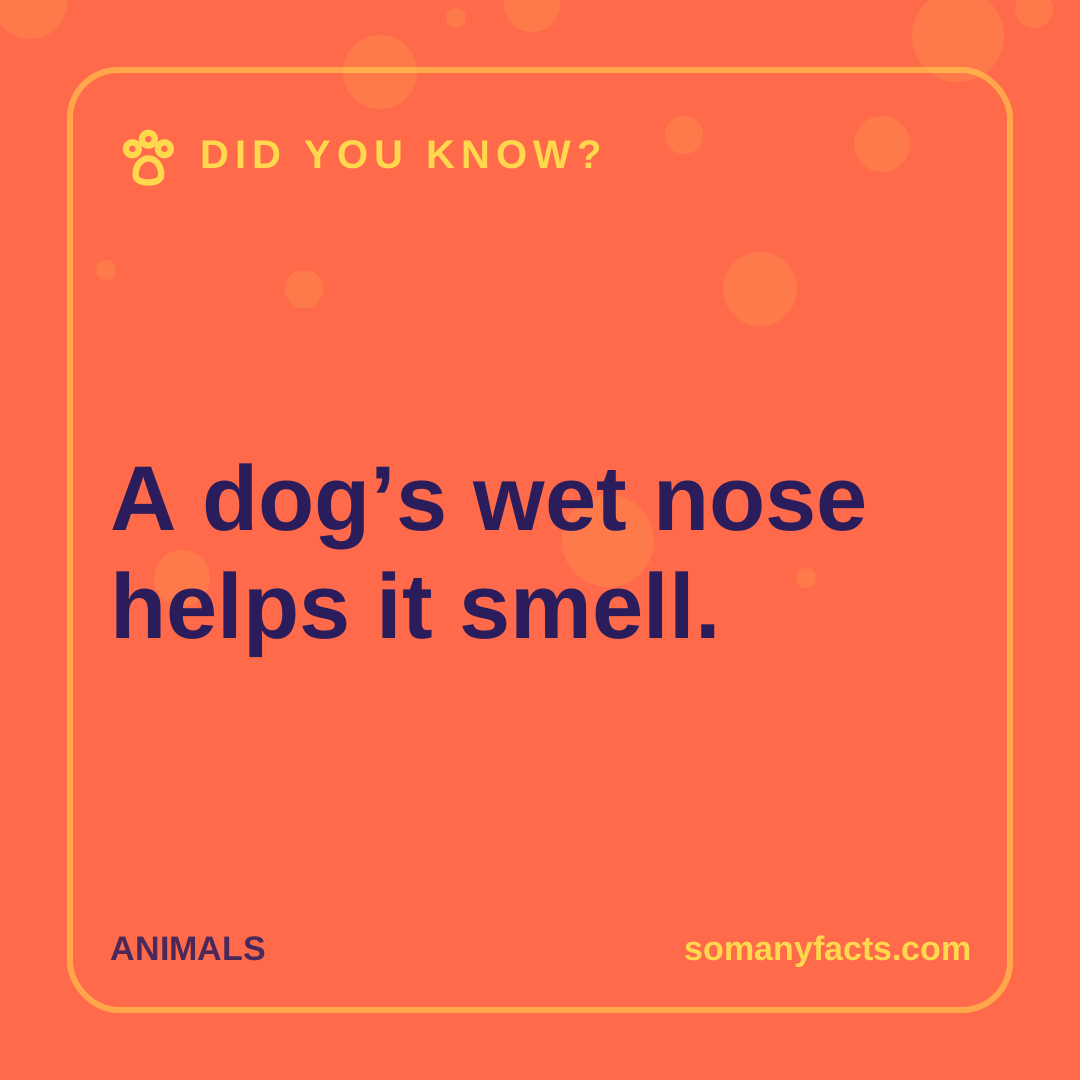
A dog’s wet nose helps it smell.
A thin layer of mucus on the nose traps scent particles, and dogs lick their noses to taste the smells they have picked up.
Source: Dog anatomy (Wikipedia) · Fact card
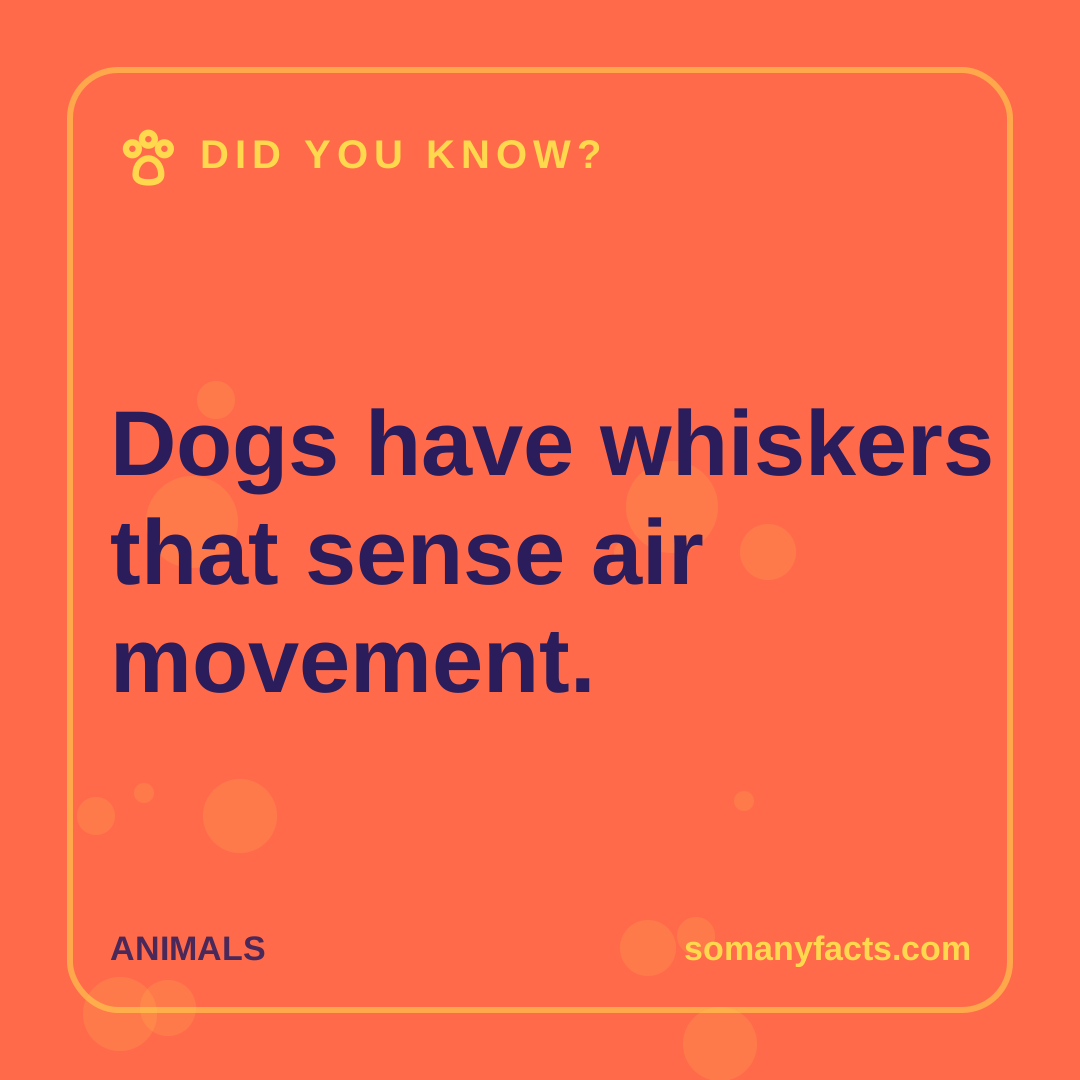
Dogs have whiskers that sense air movement.
Whiskers on the muzzle, above the eyes and under the chin are sensitive touch hairs that help dogs judge nearby objects.
Source: Whiskers (Wikipedia) · Fact card
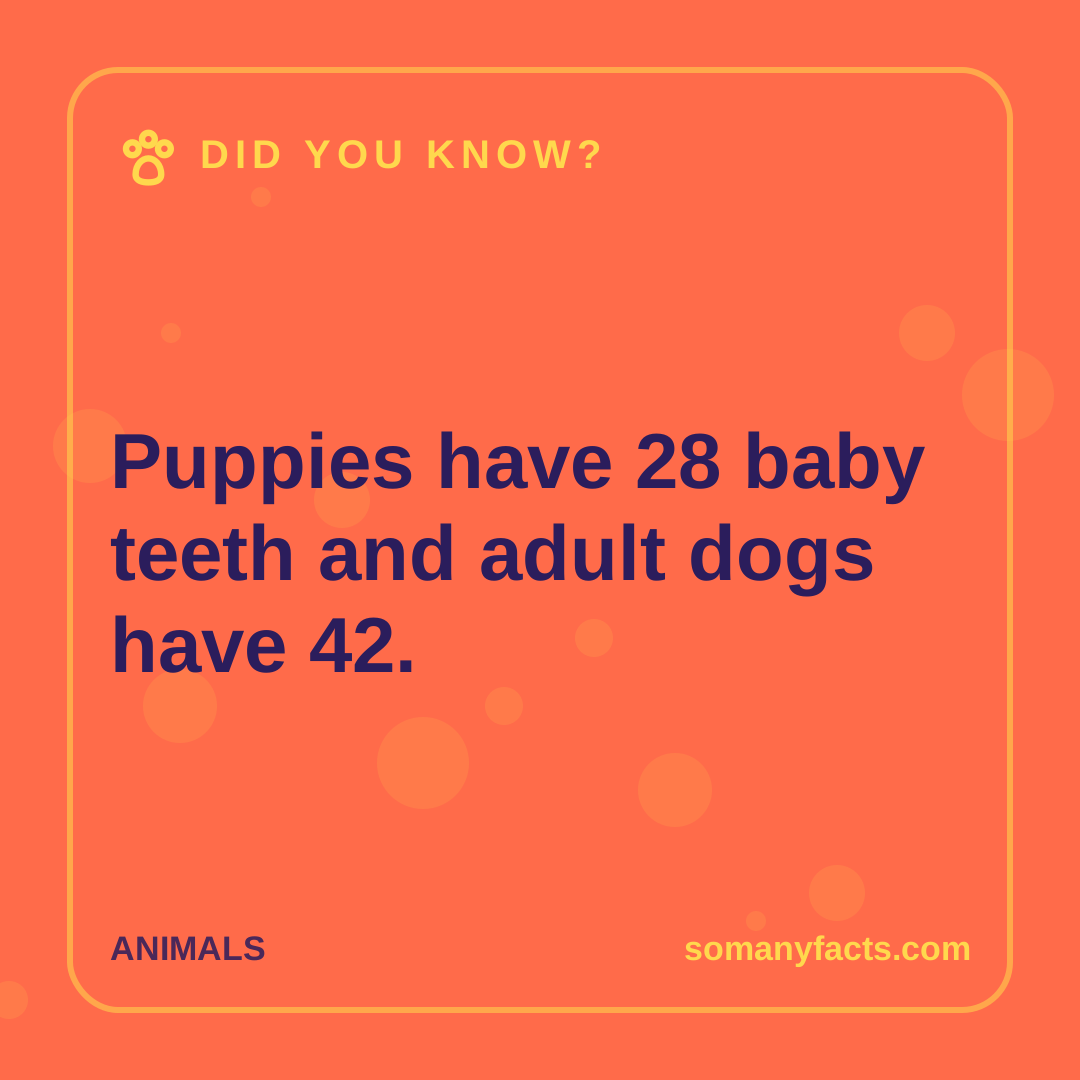
Puppies have 28 baby teeth and adult dogs have 42.
Puppies lose their baby teeth between about three and seven months old as the adult teeth come through.
Source: Dog anatomy (Wikipedia) · Fact card
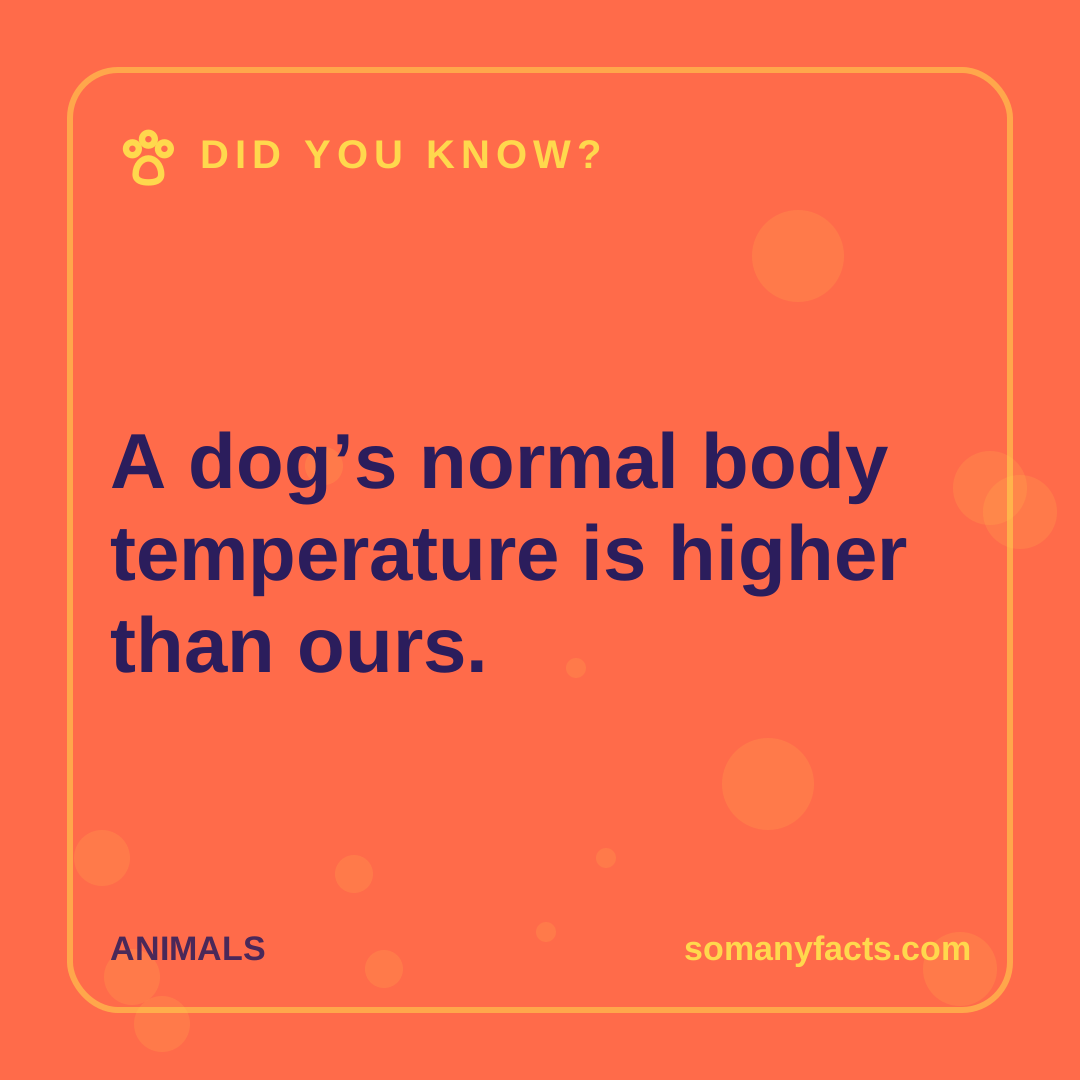
A dog’s normal body temperature is higher than ours.
Healthy dogs usually run at around 38 to 39°C, a degree or two warmer than people.
Source: Dog anatomy (Wikipedia) · Fact card
Which way a dog wags its tail may mean something.
Researchers found dogs tend to wag more to the right when they see something they like, such as their owner, and more to the left when they see something unsettling.
Source: Tail wagging by dogs (Wikipedia) · Fact card
Bloodhounds are such good trackers that their trails have been used as evidence in court.
Bloodhounds can follow a scent trail days old over long distances, and US courts have accepted their tracking in some cases.
Source: Bloodhound (Wikipedia) · Fact card
A border collie named Chaser learned the names of more than 1,000 toys.
Chaser, studied by psychologist John Pilley, could fetch any of over 1,000 named objects on command.
Source: Chaser (dog) (Wikipedia) · Fact card
Sled dogs carried medicine across Alaska in 1925 to stop a diphtheria outbreak.
Relay teams of sled dogs covered about 1,085 kilometers to bring antitoxin to Nome. Balto, who led the final stretch, has a statue in New York’s Central Park.
Source: 1925 serum run to Nome (Wikipedia) · Fact card
A dog in Japan waited for his owner at a train station for nearly 10 years.
Hachikō waited at Shibuya Station every day after his owner died in 1925. A statue of him stands outside the station today.
Source: Hachikō (Wikipedia) · Fact card
Dogs dream.
Dogs have sleep cycles with REM sleep like ours, and twitching paws or soft barks during sleep are thought to be signs of dreaming.
Source: Dog (Wikipedia) · Fact card
Some dogs hunt by sight, others by smell.
Sighthounds such as greyhounds and salukis chase what they see, while scent hounds such as beagles and bloodhounds follow their noses.
Source: Sighthound (Wikipedia) · Fact card
Newfoundland dogs have webbed feet and are famous water rescuers.
Their webbed paws, water-resistant coat and strength made them working dogs for fishermen, and they are still trained for water rescue.
Source: Newfoundland dog (Wikipedia) · Fact card
Dogs pant to cool down.
Panting moves air over the moist tongue and airways, and the evaporating water carries heat away from the body.
Source: Panting (Wikipedia) · Fact card
Small dog breeds usually live longer than big ones.
Many small breeds live 12 to 16 years, while giant breeds often live 8 to 10, the opposite of the pattern across most animal species.
Source: Dog (Wikipedia) · Fact card
Dogs can read human facial expressions.
Studies show dogs can tell happy faces from angry ones and look at human faces differently from other animals.
Source: Human-canine bond (Wikipedia) · Fact card
Pet cats descend from the African wildcat.
Genetic studies show domestic cats come from the African wildcat of the Near East, which began living around early farming villages about 10,000 years ago.
Source: African wildcat (Wikipedia) · Fact card
Cats spend a lot of their waking time grooming.
Cats groom to keep clean, control body temperature and spread scent, and can spend a large share of their waking hours doing it.
Source: Cat behavior (Wikipedia) · Fact card
A cat’s tongue is covered in tiny hooks.
Backward-facing spines called papillae act like a comb, pulling loose fur and dirt out during grooming.
Source: Cat anatomy (Wikipedia) · Fact card
Kneading is a habit cats keep from kittenhood.
Kittens knead their mother to help milk flow. Adult cats often knead soft blankets or laps when they feel content.
Source: Cat behavior (Wikipedia) · Fact card
Cats need about one sixth of the light we need to see.
A reflective layer behind the retina, the tapetum lucidum, bounces light back through the eye. It is also why cats’ eyes glow in headlights.
Source: Cat senses (Wikipedia) · Fact card
Cats can hear sounds far higher than people can.
Cats hear up to about 64,000 hertz, well above the human limit of around 20,000 hertz, which helps them hear the squeaks of rodents.
Source: Cat senses (Wikipedia) · Fact card
Cats can jump several times their own height.
Powerful back legs and a flexible spine let cats leap onto surfaces up to about five or six times their body length above the ground.
Source: Cat anatomy (Wikipedia) · Fact card
Most orange cats are male.
The gene for orange fur sits on the X chromosome. Males need only one copy to be orange, so roughly 80% of orange cats are male.
Source: Orange cat (Wikipedia) · Fact card
Almost all calico and tortoiseshell cats are female.
These coat patterns need two X chromosomes, so male calicos are rare and usually sterile.
Source: Calico cat (Wikipedia) · Fact card
Cats can taste ATP, a chemical in meat that people cannot taste.
ATP (adenosine triphosphate) is found in living cells, so tasting it may help cats pick fresh prey.
Source: Cat senses (Wikipedia) · Fact card
Cats sweat through their paws.
Their sweat glands are mostly in the paw pads, which is why a nervous cat can leave damp paw prints.
Source: Cat anatomy (Wikipedia) · Fact card
A French cat named Félicette went to space in 1963.
Félicette flew on a French sounding rocket and was recovered alive after a 13-minute flight, the only cat to have gone to space.
Source: Félicette (Wikipedia) · Fact card
The Maine Coon is one of the largest domestic cat breeds.
Males often weigh 6 to 8 kilograms, and the breed is the official state cat of Maine.
Source: Maine Coon (Wikipedia) · Fact card
Cats’ whiskers are as wide as their bodies.
The whiskers on the muzzle roughly match the width of the cat, which is one reason they are good guides to tight spaces.
Source: Whiskers (Wikipedia) · Fact card
Cats sailed on ships for centuries to catch rats.
Ship’s cats protected food stores and ropes from rodents, and some, such as Unsinkable Sam, became famous.
Source: Ship’s cat (Wikipedia) · Fact card
There are more than 500 species of shark.
They range from the dwarf lanternshark, small enough to hold in your hand, to the whale shark.
Source: List of sharks (Wikipedia) · Fact card
One of the smallest sharks is about 20 centimeters long.
The dwarf lanternshark lives deep in the Caribbean and can glow in the dark.
Source: Dwarf lanternshark (Wikipedia) · Fact card
Some sharks glow in the dark.
Lanternsharks and others make their own light, which may help camouflage them from below.
Source: Lanternshark (Wikipedia) · Fact card
Great white sharks can grow to about 6 meters long.
They are the largest predatory fish, feeding on seals, fish and dolphins.
Source: Great white shark (Wikipedia) · Fact card
Sharks have an excellent sense of smell.
Some sharks can detect blood at concentrations as low as about one part per million.
Source: Shark (Wikipedia) · Fact card
Sharks can feel vibrations in the water.
A line of sensory cells along each side, the lateral line, picks up movement and pressure changes from prey.
Source: Lateral line (Wikipedia) · Fact card
Some sharks lay eggs in leathery cases called mermaid’s purses.
Others give birth to live young. Empty egg cases often wash up on beaches.
Sand tiger shark embryos eat their siblings before birth.
The largest embryo in each womb eats the others, so only one pup is born from each side.
Source: Sand tiger shark (Wikipedia) · Fact card
Flipping some sharks upside down makes them go still.
This trance-like state is called tonic immobility, and researchers use it to handle sharks safely.
Source: Tonic immobility (Wikipedia) · Fact card
The shortfin mako is the fastest shark.
It can reach bursts of about 70 km/h and leap high out of the water.
Source: Shortfin mako shark (Wikipedia) · Fact card
Bull sharks can live in fresh water.
They have been found far up rivers such as the Mississippi and the Amazon.
Source: Bull shark (Wikipedia) · Fact card
A shark’s skeleton is made of cartilage, the same material as your nose and ears.
Cartilage is lighter and more flexible than bone, which helps sharks stay buoyant and turn quickly.
Source: Cartilage (Wikipedia) · Fact card
The extinct megalodon was one of the largest predators ever.
It lived until about 3.6 million years ago and may have reached 15 meters or more. We know it mostly from huge fossil teeth.
Source: Megalodon (Wikipedia) · Fact card
Each whale shark has a unique pattern of spots.
Scientists identify individuals from photos of their spots, using software first designed for star maps.
Source: Whale shark (Wikipedia) · Fact card
Tiger sharks are known to eat almost anything.
Their stomachs have contained turtles, birds, tires and license plates.
Source: Tiger shark (Wikipedia) · Fact card
Many shark species are threatened with extinction.
Overfishing, including for shark fins, has cut some populations sharply, and about a third of shark and ray species are threatened.
Source: Shark finning (Wikipedia) · Fact card
Nurse sharks suck in their prey like a vacuum.
They rest on the sea floor and use powerful suction to pull fish and shellfish from crevices.
Source: Nurse shark (Wikipedia) · Fact card
The goblin shark can shoot its jaws forward to grab prey.
This rarely seen deep-sea shark has a long flat snout and slingshot jaws.
Source: Goblin shark (Wikipedia) · Fact card
There are about 18 species of penguin.
They range from the little penguin of Australia and New Zealand to the emperor penguin of Antarctica.
Source: Penguin (Wikipedia) · Fact card
King penguins are the second-largest penguins.
They stand about 90 centimeters tall and live on sub-Antarctic islands such as South Georgia.
Source: King penguin (Wikipedia) · Fact card
Adélie penguins are named after a French explorer’s wife.
Explorer Jules Dumont d’Urville named Adélie Land in Antarctica, and the penguin, after his wife Adèle in 1840.
Source: Adélie penguin (Wikipedia) · Fact card
Chinstrap penguins are named for the thin black line under their chin.
They are among the most numerous penguins and nest on rocky slopes in Antarctica and nearby islands.
Source: Chinstrap penguin (Wikipedia) · Fact card
Macaroni penguins are named after an 18th-century fashion.
Their yellow head plumes reminded English sailors of "macaronis", young men who wore flamboyant hats and feathers.
Source: Macaroni penguin (Wikipedia) · Fact card
African penguins bray like donkeys.
Their loud calls earned them the old name "jackass penguin". They live on the coasts of South Africa and Namibia.
Source: African penguin (Wikipedia) · Fact card
You can watch wild penguins on a beach near Cape Town.
A colony of African penguins lives at Boulders Beach in Simon’s Town, where boardwalks let visitors watch them.
Source: Boulders Beach (Wikipedia) · Fact card
Penguins replace all their feathers at once every year.
During this "catastrophic molt" they cannot swim, so they fatten up beforehand and fast on land for two to three weeks.
Source: Moulting (Wikipedia) · Fact card
Many penguins live mainly on krill, fish and squid.
Krill, tiny shrimp-like animals, are a key food for Adélie and chinstrap penguins in the Southern Ocean.
Source: Antarctic krill (Wikipedia) · Fact card
Penguins leap out of the water as they swim.
This "porpoising" lets them breathe without slowing down and may help them escape predators.
Source: Penguin (Wikipedia) · Fact card
Penguins slide on their bellies to travel over ice.
Called tobogganing, it saves energy compared with waddling.
Source: Penguin (Wikipedia) · Fact card
Leopard seals are a major predator of penguins.
They often wait near the ice edge where penguins enter the water.
Source: Leopard seal (Wikipedia) · Fact card
Penguin parents find their chicks among thousands by sound.
Each penguin has a distinctive call, and parents and chicks recognize each other’s voices in noisy colonies.
Source: Emperor penguin (Wikipedia) · Fact card
Penguins sneeze out salt.
A gland above the eyes filters extra salt from the blood, which then drips out of the bill.
Source: Supraorbital gland (Wikipedia) · Fact card
The African penguin is critically endangered.
Its numbers have fallen sharply because of food shortages, oil spills and habitat loss.
Source: African penguin (Wikipedia) · Fact card
The yellow-eyed penguin of New Zealand is one of the rarest penguins.
It nests in coastal forest and scrub and appears on New Zealand’s five-dollar note.
Source: Yellow-eyed penguin (Wikipedia) · Fact card
World Penguin Day is celebrated on 25 April.
The date is linked to the annual northward migration of Adélie penguins in Antarctica.
Source: Penguin (Wikipedia) · Fact card
There are more than 200 species of owl.
Owls live on every continent except Antarctica.
Source: Owl (Wikipedia) · Fact card
The elf owl is one of the smallest owls in the world.
It is about the size of a sparrow and often nests in old woodpecker holes in saguaro cacti in the US Southwest and Mexico.
Source: Elf owl (Wikipedia) · Fact card
Blakiston’s fish owl is one of the largest owls and catches fish.
It lives along rivers in eastern Russia, northern China and Japan, and is endangered.
Source: Blakiston’s fish owl (Wikipedia) · Fact card
A barn owl’s heart-shaped face works like a satellite dish.
The facial disk funnels sound to the ears, helping it hunt by hearing alone.
Source: Barn owl (Wikipedia) · Fact card
The barn owl is one of the most widespread birds in the world.
It lives on every continent except Antarctica.
Source: Barn owl (Wikipedia) · Fact card
Owls can swivel one toe backward.
Their outer toe can point forward or back, so they can grip prey with two toes in front and two behind.
Source: Owl (Wikipedia) · Fact card
Owls are far-sighted.
They see distant objects clearly but cannot focus well on things very close to their eyes, so they use bristly feathers around the beak to feel food.
Source: Owl (Wikipedia) · Fact card
An owl’s "ears" on top of its head are just feathers.
Ear tufts on owls like the great horned owl are for display and camouflage. The real ears are openings on the sides of the head.
Source: Great horned owl (Wikipedia) · Fact card
Great horned owls are one of the few animals that regularly eat skunks.
Like most birds, they have a poor sense of smell.
Source: Great horned owl (Wikipedia) · Fact card
In ancient Greece, the little owl was a symbol of wisdom and of the goddess Athena.
Athenian silver coins carried an owl, which is why the bird became linked with wisdom in Western culture.
Source: Owl of Athena (Wikipedia) · Fact card
Harry Potter’s owl Hedwig is a snowy owl.
In the films she was played by several trained male snowy owls, which are whiter than the speckled females.
Source: Snowy owl (Wikipedia) · Fact card
Not all owls are nocturnal.
Burrowing owls and northern hawk owls are often active by day, and many owls hunt at dawn and dusk.
Source: Owl (Wikipedia) · Fact card
The classic "hoot" is mostly a territorial call.
Male and female tawny owls famously duet, one calling "ke-wick" and the other answering "hoo-hoo".
Source: Tawny owl (Wikipedia) · Fact card
Many owls are camouflaged to look like tree bark.
Mottled brown and grey feathers let owls roost in daylight without being seen.
Source: Owl (Wikipedia) · Fact card
Small birds gang up on owls in daylight.
Called mobbing, crowds of songbirds dive and call at a roosting owl to drive it away.
Owl eggs are almost always white.
Most owls nest in holes or hidden places, so their eggs do not need camouflage.
Source: Owl (Wikipedia) · Fact card
Owl chicks hatch days apart.
Owls start incubating as soon as the first egg is laid, so siblings in one nest can be very different sizes.
Source: Owl (Wikipedia) · Fact card
Snowy owls can eat over 1,000 lemmings a year.
Lemmings are their main food in the Arctic, and snowy owls lay more eggs in years when lemmings are plentiful.
Source: Snowy owl (Wikipedia) · Fact card
The northern spotted owl became a symbol of US forest protection.
Its listing as threatened in 1990 led to major limits on logging old-growth forests in the Pacific Northwest.
Source: Northern spotted owl (Wikipedia) · Fact card
Barn owls can catch mice in complete darkness.
Experiments showed barn owls can locate prey by sound alone with remarkable accuracy.
Source: Barn owl (Wikipedia) · Fact card
Rockhopper penguins hop from rock to rock.
Instead of sliding or waddling, they jump with both feet together up steep, rocky shores.
Source: Rockhopper penguin (Wikipedia) · Fact card
Topics: Space Planet Earth Food Human body History Science Words Tech Countries and states
Facts about: Kids The planets Ocean animals Cats Dogs Sharks Penguins Owls Mars Jupiter Saturn Neptune Venus The Moon The Sun Japan Italy Mexico Texas Florida Hawaii