 Human body
15 sourced facts
Human body facts
Surprising human body facts that are actually true. Tap any card for the details and the source, then download or share it.
Human body Human body
 Human body
 Human body
 Human body
 Human body
 Human body
 Human body
 Human body
 Human body
 Human body
 Human body
 Human body
 Human body
 Human body
 facts: all 15, explained
Babies are born with more bones than adults.
A newborn has around 300 bones and cartilage pieces, while an adult has 206. Many of them fuse together as we grow, such as the plates of the skull and the bones at the base of the spine.
Source: Human skeleton (Wikipedia) · Fact card
Your stomach gets a new lining every few days.
The stomach makes strong acid to digest food, so the cells lining it are constantly being replaced. A layer of mucus also protects the stomach wall from its own acid.
Source: Stomach (Wikipedia) · Fact card
Your nose can tell apart a huge range of smells.
Humans have around 400 types of smell receptors. Smell signals go to brain areas closely linked to memory and emotion, which is why a smell can bring back a memory so strongly.
Source: Olfaction (Wikipedia) · Fact card
The thigh bone is the longest and strongest bone in the human body.
The femur makes up roughly a quarter of a person’s height. It is so strong that it can support many times your body weight when you walk, run or jump.
Source: Femur (Wikipedia) · Fact card
Laid end to end, your blood vessels could wrap around the world about twice.
By common estimates, an adult’s arteries, veins and capillaries add up to as much as 100,000 kilometres, most of it in the tiny capillaries. The Earth’s circumference is about 40,000 kilometres.
Source: Circulatory system (Wikipedia) · Fact card
You are slightly taller in the morning than at night.
During the day, gravity compresses the soft discs between the bones of your spine. Lying down at night lets them expand again, so most people are around a centimetre taller when they wake up.
Source: Intervertebral disc (Wikipedia) · Fact card
The smallest bone in your body is in your ear.
The stapes, or stirrup, is about 3 millimetres long. It is one of three tiny bones in the middle ear that pass sound vibrations to the inner ear.
Source: Stapes (Wikipedia) · Fact card
The cornea has no blood vessels.
The clear front surface of the eye gets its oxygen mostly straight from the air and from the fluids around it. Having no blood vessels keeps it transparent so light can pass through.
Source: Cornea (Wikipedia) · Fact card
Your body gives off a faint glow you cannot see.
Chemical reactions in our cells release a tiny amount of visible light. A 2009 study in Japan photographed it with ultra-sensitive cameras. It is about 1,000 times too weak for our eyes to see.
Source: Bioluminescence (Wikipedia) · Fact card
Your heart beats about 100,000 times a day.
At a resting rate of 60 to 100 beats a minute, the heart beats roughly 100,000 times a day and over 2.5 billion times in an average lifetime.
Source: Heart (Wikipedia) · Fact card
Head hair grows about 1 cm a month.
Scalp hair grows roughly 15 centimetres a year. Each hair grows for several years, then rests and falls out, which is why most people lose dozens of hairs a day.
Source: Hair (Wikipedia) · Fact card
Fingernails grow faster than toenails.
Fingernails grow about 3 millimetres a month, around three or four times faster than toenails.
Source: Nail (anatomy) (Wikipedia) · Fact card
You blink around 15 to 20 times a minute.
Blinking spreads tears over the eye to keep it moist and clean. People blink less when concentrating on screens, which can make eyes feel dry.
Source: Blinking (Wikipedia) · Fact card
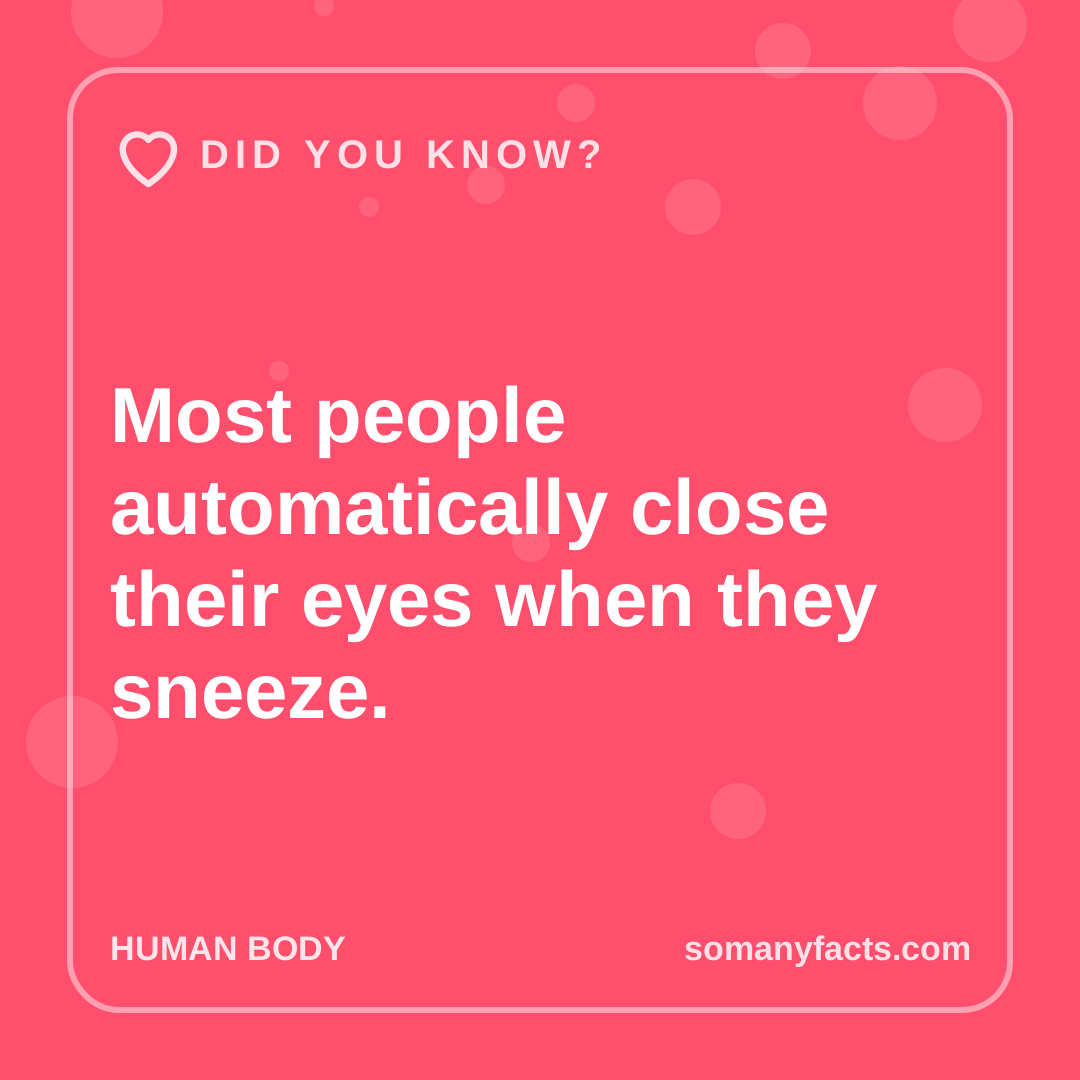
Most people automatically close their eyes when they sneeze.
Closing the eyes during a sneeze is an involuntary reflex. It is not true that your eyes would pop out if you kept them open.
Source: Sneeze (Wikipedia) · Fact card
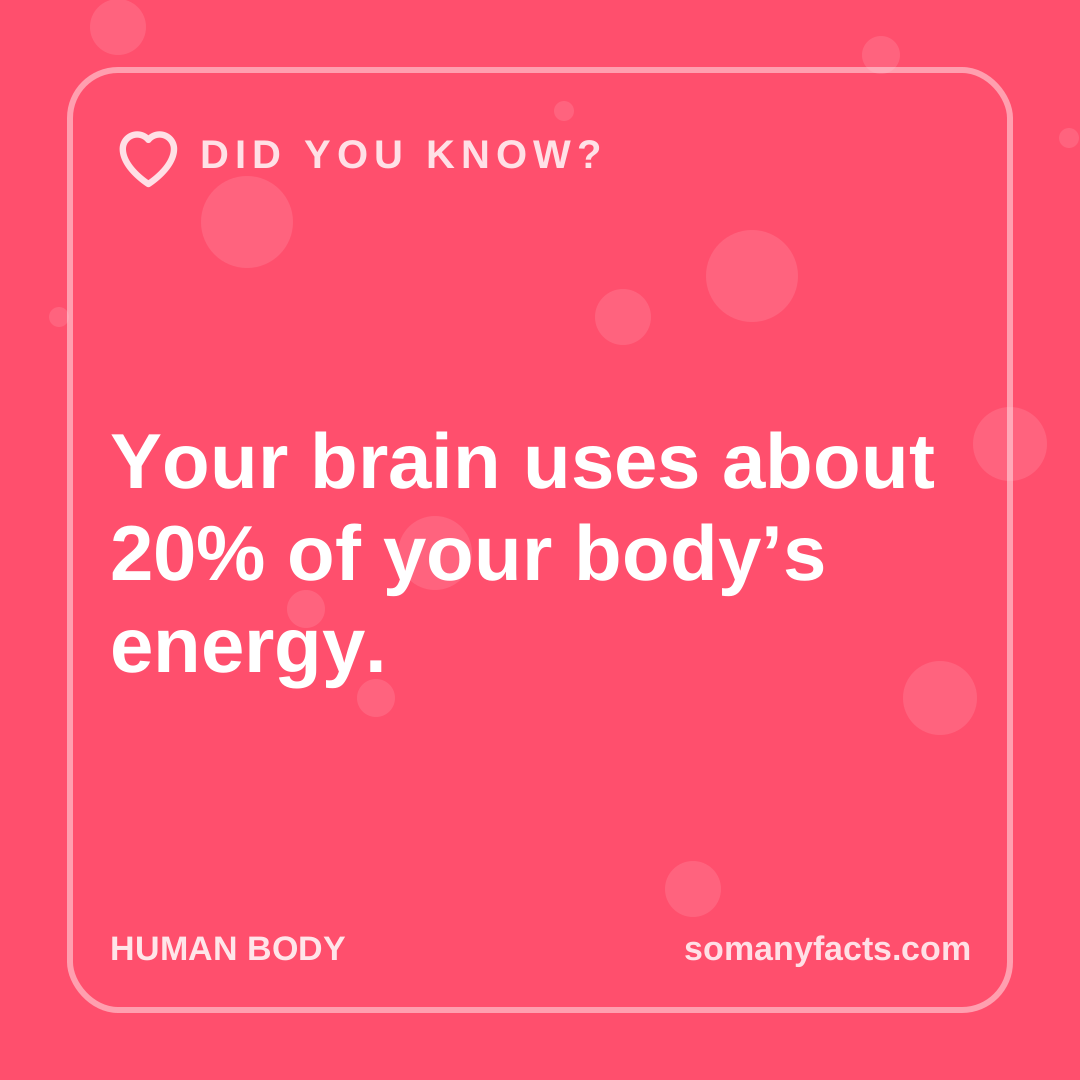
Your brain uses about 20% of your body’s energy.
The brain makes up about 2% of body weight but uses roughly a fifth of the body’s energy at rest.
Source: Human brain (Wikipedia) · Fact card
Topics: Animals Space Planet Earth Food History Science Words Tech Countries and states
Facts about: Kids The planets Ocean animals Cats Dogs Sharks Penguins Owls Mars Jupiter Saturn Neptune Venus The Moon The Sun Japan Italy Mexico Texas Florida Hawaii