 Animals
58 sourced facts
Fun Facts for Kids
Amazing true facts for curious kids, about animals, space, the body and more. Every fact is checked and has a source, so they are great for school projects, quizzes and car journeys.
Animals Animals
 Animals
 Animals
 Food
 Animals
 Animals
 Animals
 Animals
 Animals
 Animals
 Space
 Space
 Human body
 Food
 Animals
 Animals
 Animals
 Animals
 Animals
 Animals
 Animals
 Animals
 Animals
 Animals
 Animals
 Animals
 Animals
 Space
 Space
 Space
 Food
 Human body
 Human body
 Science
 Science
 Science
 Animals
 Animals
 Animals
 Space
 Space
 Space
 Animals
 Animals
 Animals
 Animals
 Animals
 Space
 Space
 Animals
 Space
 Space
 Animals
 Animals
 Space
 Space
 Countries and states
Fun Facts for Kids: all 58, explained
An octopus has three hearts.
Two hearts pump blood through the gills, and the third pumps it around the rest of the body. The main heart actually stops beating while the octopus swims, which is one reason octopuses prefer crawling. Their blood is blue because it uses a copper-based protein, hemocyanin, to carry oxygen.
Source: Octopus (Wikipedia) · Fact card
Wombats produce cube-shaped poop.
Wombat droppings come out as rough cubes, and a wombat can produce dozens a night. Researchers found the shape forms in the last part of the intestine, where the gut walls stretch unevenly. Wombats stack the cubes on rocks and logs to mark territory, and the flat sides stop them rolling away.
Source: Wombat (Wikipedia) · Fact card
Sea otters hold hands while they sleep so they don’t drift apart.
Sea otters rest floating on their backs, and groups called rafts sometimes link paws or wrap themselves in kelp to stay together on the current. They also have the densest fur of any animal, which keeps them warm without a layer of blubber.
Source: Sea otter (Wikipedia) · Fact card
Flamingos are pink because of what they eat.
Flamingo chicks are born grey or white. Their pink color comes from carotenoid pigments in the algae and brine shrimp they eat. A flamingo on a poor diet slowly fades towards white, which is why zoos add carotenoids to their food.
Source: Flamingo (Wikipedia) · Fact card
Honey can last for thousands of years.
Honey is low in water, slightly acidic and contains small amounts of hydrogen peroxide, so bacteria struggle to grow in it. Archaeologists have found pots of honey in ancient Egyptian tombs. Stored sealed, honey can crystallise but stays safe to eat.
Source: Honey (Wikipedia) · Fact card
Koalas have fingerprints almost identical to humans.
Koala fingerprints have loops and whorls so similar to ours that they are hard to tell apart even under a microscope. They evolved separately from primate fingerprints, probably to help koalas grip branches and handle eucalyptus leaves.
Source: Koala (Wikipedia) · Fact card
Starfish have no brain and no blood.
Sea stars use a network of nerves instead of a brain, and they move water through their bodies instead of blood. Many species can regrow lost arms, and some can regrow an entire body from a single arm with part of the central disc.
Source: Starfish (Wikipedia) · Fact card
Hummingbirds are the only birds that can fly backwards.
Hummingbirds rotate their wings in a figure-eight pattern, which lets them hover in place and fly backwards, a skill no other bird group has for sustained flight. Their hearts can beat more than 1,000 times a minute during flight.
Source: Hummingbird (Wikipedia) · Fact card
Elephants are one of the few mammals that cannot jump.
Adult elephants are too heavy and their leg bones point straight down, without the springy ankles other mammals use to push off. They can still walk fast, reaching around 25 km/h, while always keeping at least one foot on the ground.
Source: Elephant (Wikipedia) · Fact card
A blue whale’s heart weighs about as much as two grown men.
The blue whale is the largest animal known to have ever lived, reaching around 30 metres long. A blue whale heart studied in Canada weighed about 180 kilograms. Its call is one of the loudest sounds made by any animal.
Source: Blue whale (Wikipedia) · Fact card
Slugs have four noses.
Slugs have two pairs of tentacles. The upper pair carries light-sensing eye spots and the lower pair is used for smell and touch, so all four tentacles can sense smell. If one is lost, it can grow back.
Source: Slug (Wikipedia) · Fact card
A day on Venus is longer than a year on Venus.
Venus takes about 243 Earth days to spin once on its axis, but only about 225 Earth days to orbit the Sun. It also spins backwards compared with most planets, so on Venus the Sun would rise in the west.
Source: Venus (Wikipedia) · Fact card
Saturn is less dense than water.
Saturn is mostly hydrogen and helium, and its average density is lower than that of water. In theory, if you had a bathtub big enough, Saturn would float, although it would not survive the experience.
Source: Saturn (Wikipedia) · Fact card
You are slightly taller in the morning than at night.
During the day, gravity compresses the soft discs between the bones of your spine. Lying down at night lets them expand again, so most people are around a centimetre taller when they wake up.
Source: Intervertebral disc (Wikipedia) · Fact card
Botanically, bananas are berries but strawberries are not.
A botanical berry develops from a single flower with one ovary and has seeds inside the flesh. Bananas, tomatoes and even avocados qualify. Strawberries are "accessory fruits", with their seeds on the outside.
Source: Berry (botany) (Wikipedia) · Fact card
Dalmatian puppies are born completely white.
Dalmatian puppies are born with plain white coats. Their famous spots start to appear after a couple of weeks and keep developing for months.
Source: Dalmatian dog (Wikipedia) · Fact card
Sharks don’t have a single bone in their bodies.
A shark’s skeleton is made of cartilage, the same flexible material in your nose and ears. Cartilage is lighter than bone, which helps sharks stay buoyant.
Source: Shark (Wikipedia) · Fact card
The biggest fish in the world is a shark that eats tiny plankton.
The whale shark can grow to about 18 metres long, but it is a gentle filter feeder. It swims with its mouth open, straining plankton and small fish from the water.
Source: Whale shark (Wikipedia) · Fact card
Emperor penguin dads keep their egg warm on their feet for about two months.
After the female lays a single egg, the male balances it on his feet under a fold of skin through the Antarctic winter, eating nothing until the chick hatches. Males huddle together in large groups to survive the cold.
Source: Emperor penguin (Wikipedia) · Fact card
Owls swallow small prey whole and cough up the bones as pellets.
Owls cannot digest bones, fur or feathers, so their stomach packs them into a pellet that the owl brings back up. Scientists and school classes dissect owl pellets to see what owls eat.
Source: Pellet (ornithology) (Wikipedia) · Fact card
A giraffe has the same number of neck bones as you: seven.
Nearly all mammals have seven neck vertebrae. In a giraffe, each one can be more than 25 centimetres long.
Source: Giraffe (Wikipedia) · Fact card
Male seahorses are the ones that get pregnant.
The female places her eggs in a pouch on the male’s belly. He fertilises and carries them until they hatch, then releases tiny baby seahorses into the water.
Source: Seahorse (Wikipedia) · Fact card
Polar bears have black skin under their white-looking fur.
A polar bear’s fur is made of hollow, transparent hairs that scatter light and look white. Underneath, its skin is black, which helps absorb heat.
Source: Polar bear (Wikipedia) · Fact card
Bats are the only mammals that can truly fly.
Flying squirrels and some other mammals glide, but bats are the only ones capable of sustained, powered flight. A bat’s wing is a thin membrane of skin stretched over very long finger bones.
Source: Bat (Wikipedia) · Fact card
Butterflies taste with their feet.
Butterflies have taste sensors on their feet. Females use them to check whether a leaf is the right plant to lay their eggs on.
Source: Butterfly (Wikipedia) · Fact card
The platypus is a mammal that lays eggs.
The platypus is one of only a few egg-laying mammals, called monotremes. It also finds food underwater by sensing electric signals from prey with its bill, and males have a venomous spur on their back legs.
Source: Platypus (Wikipedia) · Fact card
No two zebras have exactly the same stripes.
Each zebra’s stripe pattern is unique, a little like a fingerprint. Researchers use photos of stripes to identify and track individual animals.
Source: Zebra (Wikipedia) · Fact card
A cow’s stomach has four compartments.
Cows are ruminants. Their stomach has four chambers that break down tough grass with the help of microbes, and they bring food back up to chew again, which is called chewing the cud.
Source: Ruminant (Wikipedia) · Fact card
Mars is red because it’s covered in rust.
The dust and rocks on Mars contain a lot of iron oxide, the same compound as rust. Fine red dust blown into the air gives the sky an orange-pink tint too.
Source: Mars (Wikipedia) · Fact card
Venus is the hottest planet, even though Mercury is closer to the Sun.
Venus’s thick carbon dioxide atmosphere traps heat, keeping the surface at around 465 °C, hot enough to melt lead. Mercury has almost no atmosphere, so its heat escapes.
Source: Venus (Wikipedia) · Fact card
We always see the same side of the Moon.
The Moon spins once on its axis in the same time it takes to orbit Earth, so the same face always points towards us. This is called tidal locking. The far side was first photographed by a Soviet probe in 1959.
Source: Tidal locking (Wikipedia) · Fact card
The ice pop was invented by accident by an 11-year-old.
According to the story, in 1905 Frank Epperson left a cup of soda with a stirring stick outside on a cold night in San Francisco. It froze, and years later he patented the idea.
Source: Popsicle (Wikipedia) · Fact card
Your heart beats about 100,000 times a day.
At a resting rate of 60 to 100 beats a minute, the heart beats roughly 100,000 times a day and over 2.5 billion times in an average lifetime.
Source: Heart (Wikipedia) · Fact card
Fingernails grow faster than toenails.
Fingernails grow about 3 millimetres a month, around three or four times faster than toenails.
Source: Nail (anatomy) (Wikipedia) · Fact card
Hot air balloons float because hot air is lighter than cold air.
Heating the air inside the balloon makes it expand, so it is less dense than the cooler air outside. The difference creates lift, the same reason warm air rises in a room.
Source: Hot air balloon (Wikipedia) · Fact card
Rainbows are really full circles.
From the ground, the horizon cuts off the lower part, so we see an arc. From a plane or a high mountain, you can sometimes see a complete circular rainbow.
Source: Rainbow (Wikipedia) · Fact card
Snowflakes almost always have six sides.
The six-fold shape comes from the way water molecules link up as they freeze into ice crystals. Each flake grows differently as it falls through changing air.
Source: Snowflake (Wikipedia) · Fact card
Dogs can hear much higher sounds than people.
Dogs hear frequencies up to around 45,000 hertz, more than twice the upper limit for young humans. That is why a dog whistle seems silent to us.
Source: Dog anatomy (Wikipedia) · Fact card
A cat’s whiskers help it judge whether it can fit through a gap.
Whiskers are thick, deeply rooted hairs packed with nerves. They pick up tiny changes in air movement and touch, helping a cat sense objects around it in the dark.
Source: Whiskers (Wikipedia) · Fact card
Cats can swivel their ears independently, using about 30 muscles in each ear.
Each ear can rotate on its own to pinpoint a sound, and cats can hear higher-pitched sounds than dogs.
Source: Cat senses (Wikipedia) · Fact card
You would weigh only about 38% as much on Mars.
Mars is smaller and less massive than Earth, so its surface gravity is about 0.38 of ours. A 100-pound child would weigh about 38 pounds there.
Source: Mars (Wikipedia) · Fact card
The Moon’s gravity causes most of the ocean tides.
The Moon pulls on Earth’s oceans, creating bulges of water that move around the planet as Earth turns. The Sun adds a smaller pull.
Source: Tide (Wikipedia) · Fact card
Gravity on the Moon is about one sixth of Earth’s.
That is why astronauts bounced along in big hops. You could jump about six times higher on the Moon than at home.
Source: Moon (Wikipedia) · Fact card
Emperor penguins are the tallest penguins, standing about 1.1 meters tall.
Emperors breed during the Antarctic winter. Males balance the egg on their feet for about two months without eating.
Source: Emperor penguin (Wikipedia) · Fact card
Owls can turn their heads about 270 degrees.
Extra vertebrae in the neck and special blood vessels that keep blood flowing let owls look far behind them.
Source: Owl (Wikipedia) · Fact card
The Chihuahua is often called the smallest dog breed.
Many adult Chihuahuas weigh under 3 kilograms. The breed is named after the Mexican state of Chihuahua.
Source: Chihuahua (dog breed) (Wikipedia) · Fact card
Dogs pant to cool down.
Panting moves air over the moist tongue and airways, and the evaporating water carries heat away from the body.
Source: Panting (Wikipedia) · Fact card
A cat’s tongue is covered in tiny hooks.
Backward-facing spines called papillae act like a comb, pulling loose fur and dirt out during grooming.
Source: Cat anatomy (Wikipedia) · Fact card
Mars is the fourth planet from the Sun.
It orbits at an average distance of about 228 million kilometers, about one and a half times as far as Earth.
Source: Mars (Wikipedia) · Fact card
You could jump almost three times as high on Mars.
With gravity only about 38% of Earth’s, the same jump would take you nearly three times higher.
Source: Gravity of Mars (Wikipedia) · Fact card
One of the smallest sharks is about 20 centimeters long.
The dwarf lanternshark lives deep in the Caribbean and can glow in the dark.
Source: Dwarf lanternshark (Wikipedia) · Fact card
The Moon is about 384,400 kilometers away.
All the other planets in the solar system could fit in the gap between Earth and the Moon.
Source: Lunar distance (Wikipedia) · Fact card
The Moon goes through its phases every 29.5 days.
The phases happen because we see different amounts of the Moon’s sunlit half as it orbits Earth.
Source: Lunar phase (Wikipedia) · Fact card
Penguins slide on their bellies to travel over ice.
Called tobogganing, it saves energy compared with waddling.
Source: Penguin (Wikipedia) · Fact card
The elf owl is one of the smallest owls in the world.
It is about the size of a sparrow and often nests in old woodpecker holes in saguaro cacti in the US Southwest and Mexico.
Source: Elf owl (Wikipedia) · Fact card
The Sun’s surface is about 5,500 °C.
The visible surface, the photosphere, is far cooler than the core.
Source: Photosphere (Wikipedia) · Fact card
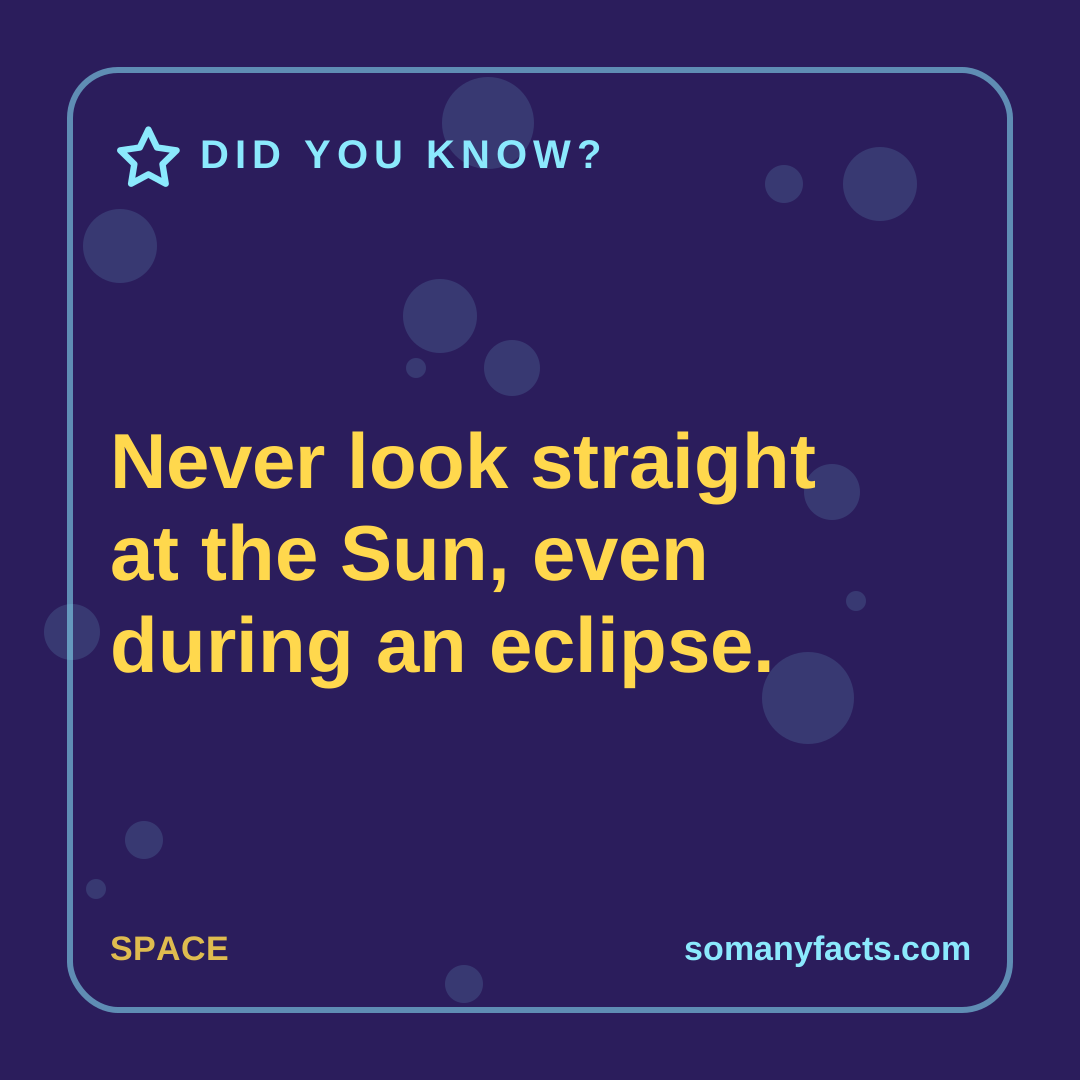
Never look straight at the Sun, even during an eclipse.
It can permanently damage your eyes. Use certified eclipse glasses or a pinhole projector.
Source: Solar eclipse (Wikipedia) · Fact card
Italy is shaped like a boot.
The "heel" is Apulia and the "toe" is Calabria, with Sicily at the tip.
Source: Italy (Wikipedia) · Fact card
Topics: Animals Space Planet Earth Food Human body History Science Words Tech Countries and states
Facts about: The planets Ocean animals Cats Dogs Sharks Penguins Owls Mars Jupiter Saturn Neptune Venus The Moon The Sun Japan Italy Mexico Texas Florida Hawaii